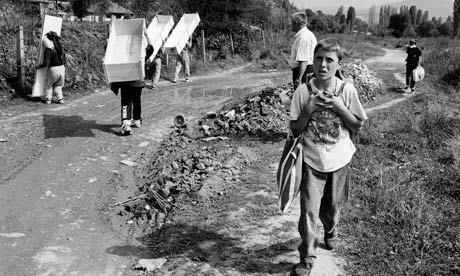
"A bit of normality", Kosovan child, by Sean Smith
So what does this have to do with me? I'm no photographer, but I know some talented people who are, and the situation makes me feel sad for them as a lot of potential avenues for this profession are disappearing. But where this affects me personally is actually in the field of translation. I'll say this right off: the biggest "intruder" in my profession today is undoubtedly Google Translate and hundreds of similar machine-based translation tools. Even though most people know that these machines turn out truly terrible translations which amount to little more than gibberish, I know for a fact that reputable companies use them in a pinch, either because they don't want to pay for a professional translation or because they just want to say that they have a website/brochure/etc. in five languages and don't care if the contents are legible. But you can't really hold a grudge against a machine, and in truth it's not really a serious competitor in my field of specialization (art and culture, literature) because most people who take the time to publish something literary or art-related are at least nominally concerned with the impression that their text will make in translation. They want to publicize their work in the English-speaking world and they know that a machine won't give them the results they want. But funds are limited thanks to the worldwide financial crisis, and costs have to be cut. Unfortunately this often means eliminating "superfluous" things like translations, or finding cheaper ways of getting texts translated. In many cases the difficulty is overcome by hiring a native speaker to do the translating in-house, often for a salary well below what a professional would earn working for him/herself, and occasionally for no pay at all (if they play dirty and take on a string of "interns" instead of hiring someone). Sometimes this works out well and the employee turns out to have a knack for translating, but in many cases the results are less than desirable. Other companies don't have enough volume of work to justify a translator on staff, so they look around for a freelancer offering cheaper rates. Unfortunately cheaper rates, or at least rates well below the generally accepted standard for translations, usually means a cheaper product. As in all markets, you get what you pay for. But non-English-speaking customers usually doesn't realize this as their rudimentary grasp of the language doesn't allow them to pick up on grammatical mistakes or awkward-sounding phrases. They just know that they've got an English translation that looks good to them for half the price.
And all this is due to a common misconception: the belief that any native speaker is capable of translating into their own language. Anyone who has seen a recent study on the average knowledge and writing skills of a U.S. college student should know that having the ability to speak one's own mother tongue, or even a university education, does not necessarily mean that a person knows how to express him/herself well in writing. Toss in the fact that a translator should have a near-native command of the source language, a good memory, the ability to think and write creatively (and coherently), and a wide vocabulary in his/her chosen area of specialization, and the pool becomes much smaller. Don't get me wrong: I'm not saying that anyone who wants to be a translator has to have a degree in translation, and I am all for encouraging people to join the profession. It's a fascinating line of work, but you have to love it and be willing to put in the time it takes to become proficient at any trade, and I have little patience for those who see translating as a way to make an easy buck rather than a painstaking labor of love. Sure, we all work for pay, but in my humble opinion translating is a lot like writing: you have to have a vocation, something inside you that makes you WANT to translate and do it well, to accurately convey not only the contents of a text but the original author's unique voice, something you find so enjoyable and enriching that you would do it for free even if you didn't have to work for a living.
Perhaps I'm too much of a perfectionist. I just think that if you're going to charge for something, you at least ought to make an attempt to do it well. I get incensed when I am asked by my clients to review translations by others and come across things like "Flamenco art of the 15th century in Holland" (flamenco in Spanish can refer to flamenco music/dance but it is also the word for Flemish, and the context here was a big clue).

Flamenco art?
Of course, I'm speaking from the perspective of a translator dealing with art and literary texts. I imagine it's different for someone translating other kinds of material, such as medical or legal texts, where accuracy is paramount but there's not much room for creativity--indeed, a "creative" translation of a medical text could be deadly. But I don't "intrude" in those fields. I know my limitations, and I stick to my area of expertise. I just wish everyone would do the same, and charge a fair rate for their work so that they don't undercut their colleagues.
Speaking of sticking to what you know, I've had a lot of opportunities to "intrude" in another profession: teaching English. I've lost track of how many times I've been asked to tutor kids struggling with their English classes or help adult professionals brush up on their business English. But I've always declined, and not because I don't want to help. I could probably be of some assistance at least informally, helping people improve their conversation and listening skills. But I don't do it for two reasons: one, I don't have the time; and two, I don't feel that I'm qualified. I think you have to have something special to be a teacher, something that makes you want to guide others along the path to knowledge and that makes them want to listen to you, and I freely admit that I don't have it. I know from friends and acquaintances who do teach that there is a lot of behind-the-scenes work involved: research, preparation, sourcing materials, designing a program suited to each age group or level of proficiency, and then the actual teaching itself. It's just not something that excites or motivates me, which suggests that I probably would be doing both my students and myself a disservice if I tried it. I have the highest respect for people who are skilled teachers, and some of them just "fell" into their profession much as I fell into mine: by trying it, finding that they were good at it, and investing time and effort in developing their skills to become ever better at what they do. So again, I'm not saying that anyone who didn't get a degree in their chosen field is an "intruder". If you take your job seriously and love what you do, that's all the qualification you need in my opinion.
So what are your thoughts on intrusismo? Does it affect you in your line of work? Is passion for one's profession a prerequisite or a luxury?

No comments:
Post a Comment