Sunday, February 17, 2013

Pinching Pennies

When I meet someone new in the US and tell them that I live in Spain, the usual reaction is "Oh, wow, how glamorous!" Those who actually know where Spain is (and that it isn't an extension of Mexico) tend to conjure up images of me lounging on the shores of the Mediterranean, flouncing around town in my ruffled flamenco dress, sipping wine at all hours of the day and night, and generally living the good life. Sadly, this picture is far from accurate. I hate to be a wet blanket and discourage potential tourists from visiting Spain, but if I replied truthfully I would say that my life here probably isn't all that different from what it might have been if I had settled somewhere Stateside. It's a whirlwind of school activities, diaper changes, laundry, housecleaning, and work, with the odd opportunity for socializing (usually with my in-laws). True, the approach to life is different here. Getting ahead professionally isn't always the top priority, and greater importance is attached to personal relationships. And when we have two cents to rub together, we try to get out and do something fun with friends or our kids rather than put them in a retirement fund (I don't think we'll ever be in a position to retire!). These are just some of the reasons why I can't envision myself ever going back to live in the US. But still, the day-to-day reality of my life in Spain is usually anything but glamorous. The difficulties imposed by the economic recession have turned me into what I swore I would never become: a thrifty house manager. Here are some of my favorite penny-pinching strategies:

Using cloth diapers. After searching in vain for a cloth diaper supplier in the Seville area, I admit that I took a short cut and asked my mother to send some items along. This makes for huge savings, as I can now stretch a pack of 30 disposable diapers (cost: 6 euros) to last an entire month. I only use them at night, as I find that baby gets too wet with the cloth variety to sleep comfortably, and when we are out and about. It makes for a bit of extra laundry, but I can handle 1 additional load every 5-6 days. I highly recommend Thirsties diaper covers and Snappi fasteners (much easier and less dangerous than safety pins).


Turning off the lights. As an American I tend to leave lights on all over the house. I'm not sure why we have this habit, but here in Spain children are raised to be very aware of the cost of electricity and turn off anything that's not in use at the moment, particularly lights. It's an uphill battle, but with some prodding from Manolo I'm becoming more power-conscious and hitting the light switch is slowly becoming second nature.

Buying meat and produce at the local market. As I do all of my grocery shopping for the week at one go, as opposed to buying each morning as most Spaniards do, the easiest thing would be to buy everything at the grocery store (my Mercadona, love it). But I've found that meat, vegetables and fruit are much cheaper at the market stalls, so I try to make time to swing by the marketplace on grocery day.


Buying our own spare parts. With two Hyundai Accents (94 and 05) that always seem to break down when we can least afford a mechanic, we've had to come up with ways of reducing the repair bills. We've found a reliable mechanic (a small miracle) who charges a reasonable hourly rate and is willing to install parts that we bring him instead of ordering directly from the manufacturer. Sometimes this isn't possible because certain parts have to be new for safety reasons, but in many cases we've been able to find parts in perfect working order at the local scrapyard for a fraction of what they would normally cost, and we've saved hundreds of euros. Desguace el Pingüino is our favorite scrapyard (I know, this smacks of trailer-park culture, but it can't be helped):


Legumes and pasta. I never knew there were so many different ways to prepare these staples until I sat down to figure out how I could cut back on monthly grocery costs. Spain has a rich tradition of potajes (stews) so I've taken notes on how my sisters-in-law prepare their garbanzos, beans and lentils, and I've scoured the internet for new recipes to spice up the menu. We now eat legumes and pasta several times a week and have less meat, which is probably good for our health and certainly great for our household economy. And I'm having fun discovering new dishes and experimenting in the kitchen.

My thrifty Scottish grandmother would be so proud of me... now if only I could convince Spaniards of the advantages of coupon clipping!

Saturday, February 9, 2013

Intruder Alert

I've been thinking a lot about intrusismo lately, primarily because of its effect on my professional life. I'm not sure if there's an exact equivalent in English; it literally means "intrusionism", the act of intruding, but what it refers to is a widespread phenomenon in certain fields, namely the "intrusion" of people who practice a profession without proper qualifications. A perfect example is photography: with the proliferation of digital cameras, today anyone with a cell/mobile phone can snap a picture and sell it to the media, effectively "intruding" on what was once the professional photographer's turf. Sure, there's still a market for quality photography, but as far as news reporting is concerned quality is beginning to take a backseat to the pressing need for fresh and sensational images, and unfortunately the ranks of professional photojournalists can't hope to compete with the millions now armed with image-capture technology. I'm not saying this is necessarily bad or good; times change, and it would be futile to try to stand in the way of progress. But it does seem a bit sad to me that people who have taken the time to study and prepare themselves, whether in the classroom or on the street, and who have invested in top-of-the-line equipment suddenly find themselves in the unemployment line or unable to work in their field because nowadays no one cares about the quality as long as a photo is newsworthy. And we are all guilty participants in this phenomenon. We all visit YouTube to view the amateur footage of a robbery caught on camera from a balcony by some bored teenager; we all peruse the blurry images of politicos up to no good, caught by a random passerby; we share them, tag them, and comment on them, and we don't care who took them. It seems that war zones and art galleries are the only options left to the pros.
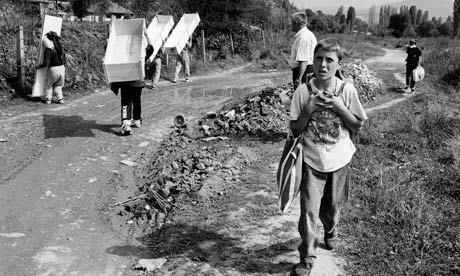
"A bit of normality", Kosovan child, by Sean Smith

So what does this have to do with me? I'm no photographer, but I know some talented people who are, and the situation makes me feel sad for them as a lot of potential avenues for this profession are disappearing. But where this affects me personally is actually in the field of translation. I'll say this right off: the biggest "intruder" in my profession today is undoubtedly Google Translate and hundreds of similar machine-based translation tools. Even though most people know that these machines turn out truly terrible translations which amount to little more than gibberish, I know for a fact that reputable companies use them in a pinch, either because they don't want to pay for a professional translation or because they just want to say that they have a website/brochure/etc. in five languages and don't care if the contents are legible. But you can't really hold a grudge against a machine, and in truth it's not really a serious competitor in my field of specialization (art and culture, literature) because most people who take the time to publish something literary or art-related are at least nominally concerned with the impression that their text will make in translation. They want to publicize their work in the English-speaking world and they know that a machine won't give them the results they want. But funds are limited thanks to the worldwide financial crisis, and costs have to be cut. Unfortunately this often means eliminating "superfluous" things like translations, or finding cheaper ways of getting texts translated. In many cases the difficulty is overcome by hiring a native speaker to do the translating in-house, often for a salary well below what a professional would earn working for him/herself, and occasionally for no pay at all (if they play dirty and take on a string of "interns" instead of hiring someone). Sometimes this works out well and the employee turns out to have a knack for translating, but in many cases the results are less than desirable. Other companies don't have enough volume of work to justify a translator on staff, so they look around for a freelancer offering cheaper rates. Unfortunately cheaper rates, or at least rates well below the generally accepted standard for translations, usually means a cheaper product. As in all markets, you get what you pay for. But non-English-speaking customers usually doesn't realize this as their rudimentary grasp of the language doesn't allow them to pick up on grammatical mistakes or awkward-sounding phrases. They just know that they've got an English translation that looks good to them for half the price.

And all this is due to a common misconception: the belief that any native speaker is capable of translating into their own language. Anyone who has seen a recent study on the average knowledge and writing skills of a U.S. college student should know that having the ability to speak one's own mother tongue, or even a university education, does not necessarily mean that a person knows how to express him/herself well in writing. Toss in the fact that a translator should have a near-native command of the source language, a good memory, the ability to think and write creatively (and coherently), and a wide vocabulary in his/her chosen area of specialization, and the pool becomes much smaller. Don't get me wrong: I'm not saying that anyone who wants to be a translator has to have a degree in translation, and I am all for encouraging people to join the profession. It's a fascinating line of work, but you have to love it and be willing to put in the time it takes to become proficient at any trade, and I have little patience for those who see translating as a way to make an easy buck rather than a painstaking labor of love. Sure, we all work for pay, but in my humble opinion translating is a lot like writing: you have to have a vocation, something inside you that makes you WANT to translate and do it well, to accurately convey not only the contents of a text but the original author's unique voice, something you find so enjoyable and enriching that you would do it for free even if you didn't have to work for a living.

Perhaps I'm too much of a perfectionist. I just think that if you're going to charge for something, you at least ought to make an attempt to do it well. I get incensed when I am asked by my clients to review translations by others and come across things like "Flamenco art of the 15th century in Holland" (flamenco in Spanish can refer to flamenco music/dance but it is also the word for Flemish, and the context here was a big clue).

Flamenco art?


Of course, I'm speaking from the perspective of a translator dealing with art and literary texts. I imagine it's different for someone translating other kinds of material, such as medical or legal texts, where accuracy is paramount but there's not much room for creativity--indeed, a "creative" translation of a medical text could be deadly. But I don't "intrude" in those fields. I know my limitations, and I stick to my area of expertise. I just wish everyone would do the same, and charge a fair rate for their work so that they don't undercut their colleagues.

Speaking of sticking to what you know, I've had a lot of opportunities to "intrude" in another profession: teaching English. I've lost track of how many times I've been asked to tutor kids struggling with their English classes or help adult professionals brush up on their business English. But I've always declined, and not because I don't want to help. I could probably be of some assistance at least informally, helping people improve their conversation and listening skills. But I don't do it for two reasons: one, I don't have the time; and two, I don't feel that I'm qualified. I think you have to have something special to be a teacher, something that makes you want to guide others along the path to knowledge and that makes them want to listen to you, and I freely admit that I don't have it. I know from friends and acquaintances who do teach that there is a lot of behind-the-scenes work involved: research, preparation, sourcing materials, designing a program suited to each age group or level of proficiency, and then the actual teaching itself. It's just not something that excites or motivates me, which suggests that I probably would be doing both my students and myself a disservice if I tried it. I have the highest respect for people who are skilled teachers, and some of them just "fell" into their profession much as I fell into mine: by trying it, finding that they were good at it, and investing time and effort in developing their skills to become ever better at what they do. So again, I'm not saying that anyone who didn't get a degree in their chosen field is an "intruder". If you take your job seriously and love what you do, that's all the qualification you need in my opinion.

So what are your thoughts on intrusismo? Does it affect you in your line of work? Is passion for one's profession a prerequisite or a luxury?

Wednesday, February 6, 2013

The Baptism of a Vegetable

This story is definitely one for the memoirs...

First, a bit of background. My husband is a "cultural Catholic" and I am a Protestant (non-practicing at the moment as I haven't found a church here that I would feel comfortable attending). As anyone familiar with Spain knows, Catholicism is deeply ingrained in this country's history and culture, and even those who no longer practice or even agree with the dictates of the Church still observe certain religious rites of passage, the main events being baptism (usually at 0-12 months of age), first communion (at 7-10 years old), and marriage. After much discussion and thought, we decided to baptize our children according to the Catholic rite, mainly because it was very important to my mother-in-law and because, if they later express a desire to do first communion or get married in a church ceremony, a baptism certificate is a must. I didn't really have any strong objections as I acknowledge the fact that the richest roots of Protestantism are found in the Catholic Church, and our commonalities far outweigh our differences.
Bobby and I in 2008
And I didn't want our kids to be oddballs or have doors closed to them that they might later want to go through. So, the decision was made, and our son Bobby (Roberto) was baptized at 6 months together with his 4-month-old cousin in the same church where his father had been baptized many moons ago (the Church of Santa Ana in Triana, Seville, a beautiful building with a great priest officiating), followed by a joint reception in Seville for family and friends. So far, so good.

Then it came time to baptize our daughter, Laurel. Our economic situation had changed at lot in 4 years and we no longer had the means to throw a big bash at a rented venue, so we decided to host a simple party at our house with just the family (with catering provided by yours truly). As we weren't going to rent a place in Seville, we thought it made sense to have the ceremony at our town's parish church so everyone wouldn't have a 40-minute drive to get to the party afterwards. Although we had never actually attended mass at this church (on the rare occasions we've gone it's always been in Seville), we knew this wouldn't be a problem as the majority of "Catholic" Spaniards rarely darken a church door except on special occasions (in the States, they would be called "Christmas and Easter Christians") and the clergy are generally resigned to this fact. So we talked to the sacristan, reserved a date, and showed up for the mandatory cursillo or "little course" that parents and godparents have to take beforehand.

The course should have rung more than a few warning bells. Instead of the usual reminders of the significance of baptism and exhortations to the godparents, the sacristan waxed eloquent about the evil people who choose not to baptize their children and the consequences for their tiny immortal souls. "Van a salir moritos" was a favorite phrase I heard several times, roughly meaning "they'll turn out to be Moors/infidels", the Moors (Muslims) being the greatest ancient enemy of Spanish Catholicism for centuries. I thought that ghost had been put to rest, but apparently not in the small-town heartland. His voice ricocheted off the church walls as he shook his finger at us to drive home the point that if our children turn out "badly", it would be entirely our fault for not raising them in the church. I was quivering in my boots for fear that I would be singled out as a heretic, as the sacristan already knew from the forms we'd filled out that I had never been baptized in the Catholic rite and--horror of horrors--we had been married in a civil rather than a religious ceremony. Part of this fear was justified, as after the speech he went around to each couple checking the information on their forms and asked us, peering suspiciously over his horn-rimmed glasses, "What's this you've put here in the 'place of marriage' field?" I had innocently put down "Seville City Hall", not knowing that what they wanted was the name of a church. I replied, "Yes, it says Ayuntamiento de Sevilla, that's where we were married." He tut-tutted (yes, he actually did!) and said, "Well, that has no validity in the eyes of the church, so we might as well just cross it out." And just like that, 8 years of marriage were stricken from the record. He also queried the name we had put down for our daughter, Laurel (my mother's name), which is unusual even in the States and here is unheard-of. He looked askance at us when we explained that it is pronounced "LAU-rel" not "Lau-REL", which is the name for bay leaf in Spanish, but no more was said so we felt that we were in the clear at least on that point.
Church of Santa María la Mayor, Sanlúcar la Mayor

I had a bad feeling about going through with the ceremony after that grueling incident, but we talked it over and decided that we didn't want to start all over again at another church, and besides, the worst was probably over. Oh ye of little foresight...

The fateful day arrived. It was just before 7 pm on a sweltering June afternoon, and we met up with Manolo's family and took our seats in the 3rd row. The church was packed, as there were 5 other couples baptizing their children at the same time, each with their retinue of friends and relatives. Sweat was trickling down our faces, babies were wailing (not ours, thankfully) and there was a murmur of hushed conversation from the back of the church. By the way, I have to say that the church itself is lovely, a 14th-century Mudejar masterpiece with a fairly simple decorative scheme that contrasts with the Baroque ostentation of many other churches in Seville... not that Baroque should be anything other than ostentatious and overly lavish, but every once in a while it's refreshing to come across a church not dripping in gilt. And the beams of late afternoon light pouring in the windows were skilfully captured by our photographer, my brother-in-law's brother who for many years was a staff photographer for the newspaper ABC. After a wait of about 10 minutes, the sacristy door finally opened and the elderly parish priest made his way to the pulpit. He grasped the microphone and said, "Now, we're about to begin the baptismal ceremony, but before we do there is something that needs to be cleared up. We have here," and he thumbed through a sheaf of papers in his hand which I recognized as the forms we had filled out for the course a month earlier, "a child whose parents have asked to christen her with the name of a vegetal (a vegetable/plant), which is obviously unacceptable. Will the parents of that child please come forward for a consultation?" Nothing stirred in the church for about 10 seconds, as I slowly came to the horrified realization that he was talking about US, and I elbowed Manolo frantically and whispered, "Hey, that's us! Go up there and see what he wants, and just explain that Laurel is a variant of Laura!" Of course he had been lost in his own thoughts and it took another 20 seconds for me to relay the message, but when he realized what had happened his features became set in that stormy look I've come to know means big trouble, and he stalked up the aisle and into the sacristy.

I have to explain that, until relatively recently, children had to be baptized with a saint's name, at least here in Spain. This is still the tradition, though it is no longer mandatory. I had initially suspected that we might have trouble with the name "Laurel" because of this, as some parishes still demand a "Christian" name, but knowing that it wasn't mandatory according to the Vatican gave me some reassurance, and knowing that the parish had been informed of our choice at least one month in advance (and having been asked about the name at the course by the sacristan) we assumed it wouldn't be an issue. But you know what they say about ASSuming things...

Back to the church. The entire congregation was abuzz, no doubt with excited whisperings about what kind of vegetable we were hoping to baptize and who this strange family was. The mother in front of me kindly suggested that we could just change the name to Laura for the ceremony, which I wouldn't have minded doing if we had been consulted in advance as one's "Christian" name has no legal effects as far as government documentation or identity. But I knew that trouble was brewing in that back office, and my husband's innate horror of being humiliated or criticized in public had almost certainly triggered a reaction that was anything but conciliatory.
Angry man, illuminated
After 15 minutes of waiting, during which my cheeks acquired a flush that had little to do with the overpowering heat and stuffiness of the building, I finally asked my brother-in-law who was acting as godfather to go check on Manolo and try to remedy the situation if possible (or at least hide the body if things had gotten out of hand). He scurried into the sacristy, and 2 minutes later all parties emerged. Manolo and his brother took their seats again, the former with a murderous look on his face and the latter looking rather sheepish, and the priest took the microphone and began the rite. I whispered, "What happened? Did you change the baptismal name to Laura?" and he glared at me and said "Not now, I'll tell you later. But she is going to be baptized with the name we chose, or we are walking out of here." The rest of the ceremony proceeded without a hitch, though the priest did look daggers at us when it was our turn at the font, and he very clearly and deliberately pronounced the name wrong (Lau-REL the plant). But we saw it through and practically ran out of the church to form a family huddle and get the scoop on what had transpired behind the scenes.

Apparently, the conversation went something like this (abbreviated version).
Manolo: So what's the problem?
Priest: I can't baptize your daughter with a pagan name, you should have known that.
M: Well, having a saint's name isn't mandatory anymore, is it?
P: Not technically, but I'm in charge here and I make the rules.
M: Well then we should have been informed of those rules a month ago when we first told you about our choice of name.
P: I can't be expected to read every form that's filled out for baptisms, it's your responsibility to comply with church norms.
M: Grrrr....
P: Why don't you look over this list of saint's names and pick one you like?
M: What, you just expect me to pick a new name out of a hat at a moment's notice? We might have considered that possibility IF we had been duly informed of the rules, but after you've used this situation to publicly embarrass me and my family there is no way in hell I'm changing the name. She was named after her SAINTED grandmother, and by God she's going to be baptized Laurel or not at all.
P: (Huffy) Fine, that's your choice.
M: Just so you know, this is going to appear in tomorrow morning's headlines. I'm a lawyer, I know what canon law says about this (he totally invented this part, but by now he's on a roll) and I can assure you that your outrageous behavior is going to be front-page news.
P: (Red-faced) Are you threatening me?
M: No, I'm just stating the facts. We comply with everything that we're told to do, we show up on time and in our places, and you can't even be bothered to read the names of the children you're baptizing until 5 minutes before the ceremony? And then feel it's your duty to make a public example of us by calling us out in front of the whole town?
P: There's no need to get upset, I'm sure we can work something out.
M: Yes, we can work it out in the press because I'm done talking.
P: But why don't you just take a look at the names and see if any appeal to you?
M: (Looking down at the list of names of the other children in today's baptism) What's this? You're baptizing a "Lola"? Who is Saint Lola?
P: Well, that's acceptable because it's a shorter version of Manuela.
M: Yes, but it's not Manuela, it's Lola. So you bend the rules for some but not for others.
ENTER THE MEDIATOR (BROTHER-IN-LAW)
BL: How's everything going in here?
P: He's threatening me!!
M: I won't consent to being treated like this!!
BL: Well, did you explain that Laurel is a variation of Laura?
SILENCE.
P: (Relieved) Well, why didn't you say so? Of course that's fine, Saint Laura is on our list, that solves it.
M: (Grumbling) Great, let's get on with it before I change my mind. (EXIT)
BL: I'm really sorry about all this.
P: (Recovering some of his aplomb) Well, I should say so. The nerve of threatening an ordained priest! Hrumph.

On retelling the story to some of our local acquaintances, they were not very surprised. Apparently this priest has been at the church for 50 years and is famous for his old-school views, pointedly critical homilies (complete with fingering individuals in the congregation for specific sins), and cantankerous nature. Of course no one had warned us of this beforehand... I'm sure the local pubs and coffee houses are still abuzz with the story of that weird couple who wasn't even properly married and then went and baptized a "vegetable".


The bay laurel, Laurus nobilis


Tuesday, February 5, 2013

Country Living

We are oddballs in Spain. And not just because I'm a "furriner"... I've gotten used to that and wear the "americana" label with pride (hint: it's a free pass to get away with wearing flip-flops in autumn and hoodies whenever you feel like it). No, the really odd thing about us is where we live. Coming from a small town in rural Maine where most people can't even see their nearest neighbor's house from their yard, I don't consider where we live particularly remote or "rural", but for Spain, where people actually like living piled on top of one another, we are waaaaaay out in the country. Our house is located in one of the "urbanizaciones" (housing developments) that grew up haphazardly on what were once privately-owned agricultural plots: people were supposed to use them to grow produce or cultivate fruit trees, but then some starting building little shacks for weekending, and the shacks gave way to houses, and some started putting in pools, and finally a few brave souls decided to live here year-round. By the time the authorities took an interest it had already become a full-fledged neighborhood with almost 300 houses. So they decided to legalize it and they're still in the process of equipping our development with all the amenities of civilization (i.e. paved streets, drinking water, sewer system, telephone service, etc.). For now we continue to "rough it": our taps have running water from a community reservoir which is clean but not drinkable by today's standards; our phones and internet connections are all provided by mobile companies as there isn't any copper wiring to speak of yet; every plot has its own sump tank for waste disposal; and at night we enjoy fabulous views of the starry sky as there are no street lights and little "luminous pollution" from neighbors, most of whom are still weekenders. Spaniards think these are sub-par living conditions and most would never choose to live in such a place, but for us it works fine.

My favorite olive tree in our back yard

Of course there are drawbacks. We can't get anywhere walking (except to the fields behind our development). We don't have mail delivery service. We have to buy bottled water in bulk. The power outages are more frequent. And we have to deal with something that rarely bothers the vast majority of Spain's population: yard work. Spanish housewives are famous for their immaculately clean homes, but I wonder what level of cleanliness they would be able to maintain if they also had to mow the lawn, whack the weeds, prune the bushes, organize the shed, clean the pool... At least I console myself with this thought when the dust bunnies start cartwheeling across the living room floor like tumbleweeds in a John Wayne flick. They'd probably take it all in stride: I've encountered few things more formidable than an "ama de casa" armed with the tools of her trade. Thank goodness I'm not Spanish and everyone accepts the fact that as an American I don't know how to keep house "properly".

But there are plenty of perks to country living in Spain. One of my favorite things is not having a live audience tuning in to every marital spat or worrying that the upstairs/downstairs neighbors are getting fed up with my wailing infant or loud-mouthed child (I have to write another entry on the volume of speech here vs. the US, a fascinating subject). We can holler at each other to our heart's content and no one will mind (if they even hear us). Another bonus is the fresh air, the greenery, the space, and the fact that I can let my boisterous boy run wild in the yard to expend his pent-up energy while I type away at my laptop on the back porch.

I can't envision myself trekking to the city park every day as most Spanish moms do; I find it hard enough to fit everything that needs doing into the available hours of each day, and a 2-hour jaunt to the park every afternoon would totally throw a wrench (a spanner for my UK pals) in the works. And in the summer it's great: we have pool parties every weekend with all the cousins, BBQs with family and friends, and warm, quiet evenings with my husband in the garden sipping tinto de verano (homemade wine spritzer).

The downside is that we are too far away for easy childcare arrangements, so we rarely get to go out, and when we do it's like packing for a week-long trip with the travel crib, diapers and changing paraphernalia, extra clothes in case of accidents or mud puddles, stroller... ugh. But everything in life is a trade-off, and on the whole we are pretty happy with our bargain.